We all feel overwhelmed at times. Times when what is expected of us and what we are capable of are two vastly different things. Imposter syndrome hits. Despair sets in. And fighting back tears, we pray, “God, I can’t do this. It’s too much!”
Like us, Moses felt out of his depth when God called. Standing in front of the Burning Bush, he was completely sure that God had taken the wrong turn somewhere on His way from Heaven and stopped at the wrong bush in front of the wrong guy. Moses was a quitter. A fugitive. A loser. At least, that’s how he saw himself. He ran from his problems forty years ago and had been hiding in the desert, dressed as a shepherd, ever since. He was stuck. And he felt he deserved it. He had earned this life.
Moses had anger management issues. He killed a foreman for beating a labourer. So, he fled the country. Alone. He just ran! For forty years, he lived in Midian, married to a local woman, and working for her father. They had two sons. Gershom and Eliezer. Talk about someone who can’t let go of the past. He named his sons after his exile! Gershom means “I am a stranger in a foreign land” and Eliezer means “God delivered me from Pharaoh’s sword!”
If you lived in Midian and Moses was your next-door neighbour, you would not brag about knowing him. Nearly 80 years old, he still complains most days, likes to talk about what ‘could have been’, and still raises his voice when he’s angry because he doesn’t really like himself. You know the type.
Open your Bible to the book of Exodus. Today we are going to look at chapters 4, 5 and 6. And together, with Moses, we are going to learn about the Power of God in our lives. Especially in the times when we feel less than. Less than worthy. Less than able. Less than God calls us to be.
“When you feel overwhelmed or inadequate, where do you turn for strength and direction?”
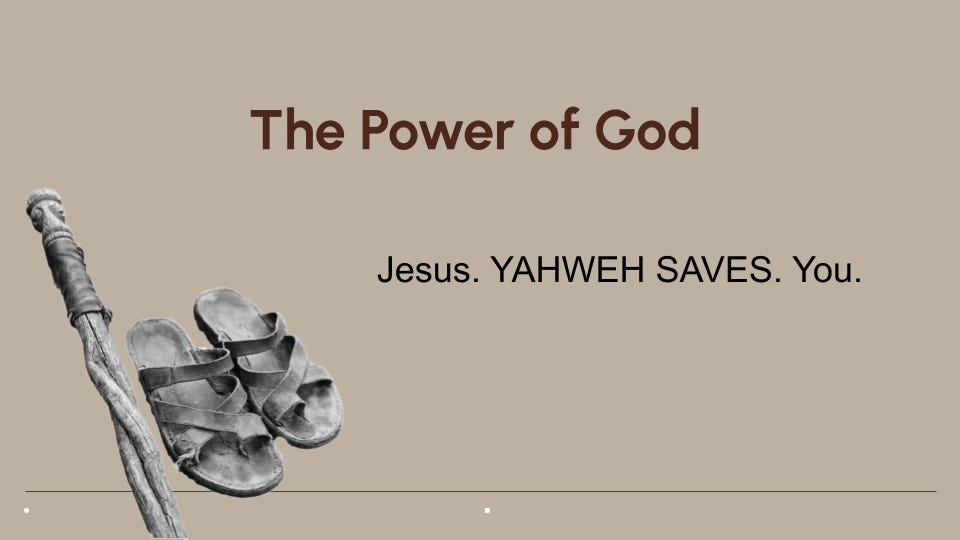
The staff of God! What a great name for a walking stick! The stick is old, but the name is new. Look back at verse 2.
Now, just a few days later, he’s named it: “The Staff of GOD!”
This is fantastic foreshadowing! It leans into the story that is about to come. It also shows us something important about human nature.
Moses saw what God could do with a stick and started calling it “The Staff of God!”
And yet, it took Moses the rest of his life to fully trust HIMSELF to God. “You can use my stick, I’ll even name it after you. But you can’t use me, I’m useless.” Eighty years of regret and self-hatred take time to overwrite.
The journey from “Who am I?” to “I am Moses, the Man of God” took the better part of another forty years. It was a long journey.
As Pastors like to say, “God does not call the equipped but equips the called.” Despite Moses’s excuses, refusals, and feelings of inadequacy, God patiently reassures him, provides signs, and even sends his brother Aaron to help.
God does not call the equipped but equips the called. Our perceived weaknesses do not hinder God’s plans; rather, they highlight His power. Our walking sticks become “The Staff of God!” And, in time, our belief in what God can do through us grows as well.
Moses begins the journey to Egypt. His brother, Aaron, meets him partway. Together, they take God’s message to the Israelite people in Egypt.
How beautiful! The people believe Moses and Aaron. They hear God’s promises and see the signs of His power. Then they bow down and worship God! Everything is going so well.
Just like that day in Egypt, the power of God is available to us today. When you trust Him, you have His power on tap! In the Exodus story, God is revealed as the ever-present and active God of deliverance. The Exodus event is not just a historical rescue; it is a profound theological statement about who God is. God is our Deliverer.
So, now, Moses and Aaron are on a high. The people believe. They saw the miracles, heard the promises, and they worshipped God! I can imagine Aaron putting his hand on Moses’ shoulder and saying, “See! Israel is with us! Because God is with us!”
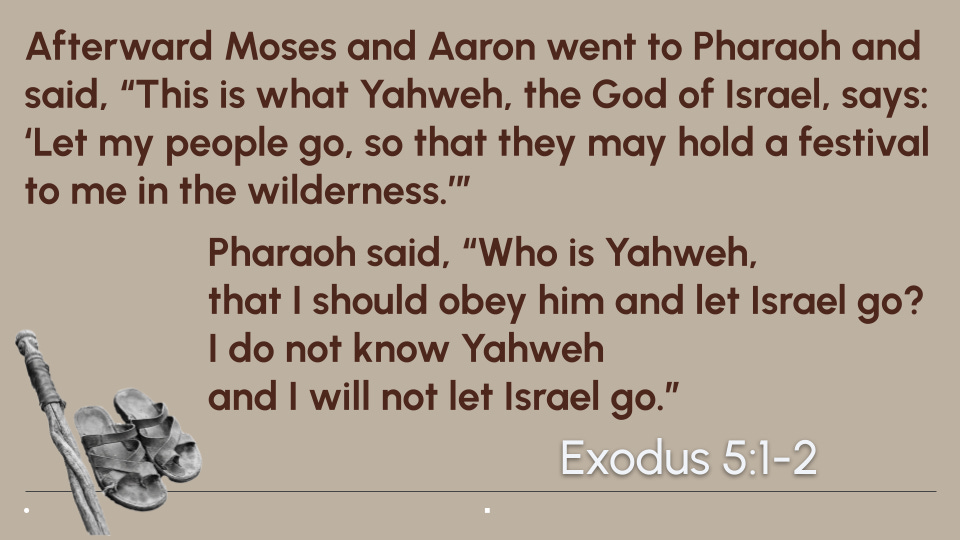
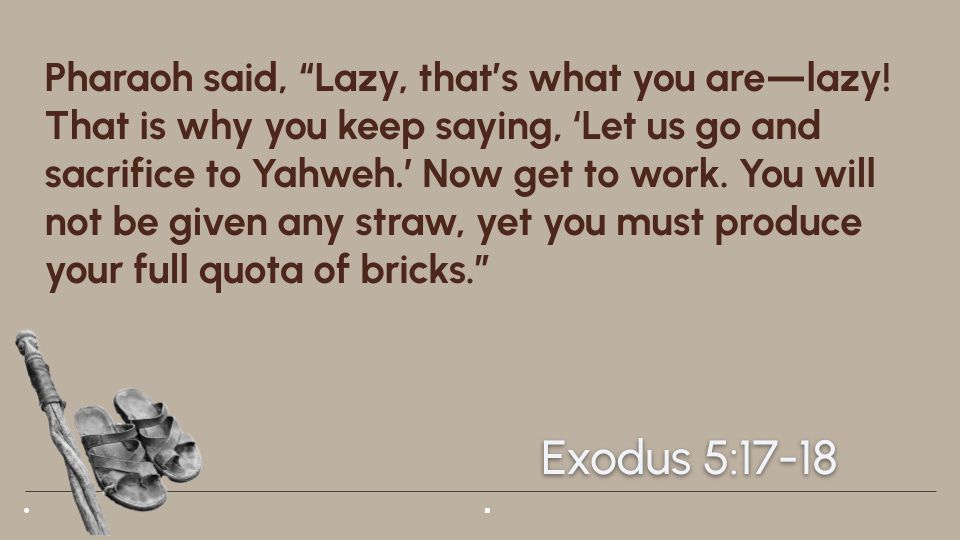
Uh oh! Sure, they didn’t expect Pharaoh to worship Yahweh. But the momentum was with them. They expected him to at least let them have their festival. But Pharaoh said no. So, Moses and Aaron repeat their demands. Pharaoh is not impressed. Then, Pharaoh realises what the problem is.
And that’s exactly what happened. Guess how happy the Israelites are, now?
Production 100. Happiness Zero.
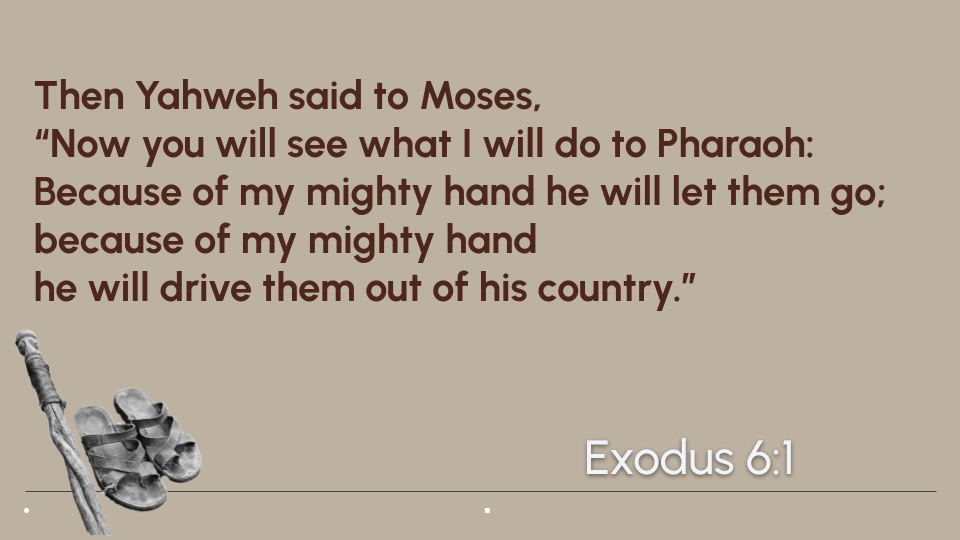
The central conflict in the story is set and ready to escalate. It’s a battle of the gods. The sovereignty of Yahweh versus the perceived divinity of Pharaoh. Yahweh steps forward.
Then God goes into a beautiful riff. Using His name for the first time, Yahweh reveals His true identity and declares all that He will do for His people.
God fully introduces himself, by name, to Moses. What an amazing honour! Then, God makes seven promises to Israel.
As the people return to their houses from a hard day at the brickyard, Moses is excited about the new promises from God. He shouts as they trudge past, “Seven promises from Yahweh! Listen, everyone! Seven promises!” But nobody is listening.
The people are tired. They are tired of working. They are tired of mud.
They want straw, not promises.
Nobody is interested in Moses’ exciting news. At all.
The next day, as they head out to work, Moses tries again. “Seven promises from Yahweh! Listen, everyone! Seven promises!” No luck. Nobody hears. The Israelites just walk past Moses, ignore Yahweh’s promises, and keep making Pharaoh’s bricks.
Moses has two final statements in chapter 6. First, in Verse 12, after God tells him to go back to Pharaoh.
With his head hanging, he takes Aaron, and they return to Pharaoh to tell him again: “Let my people go.” And again. And again.
And there is no movement in the palace. To show the slow passage of time, at this point in Chapter 6, the storyteller lists all twelve tribes of Israel and all the heads of every family in every tribe. It goes on and on for 14 very long verses.
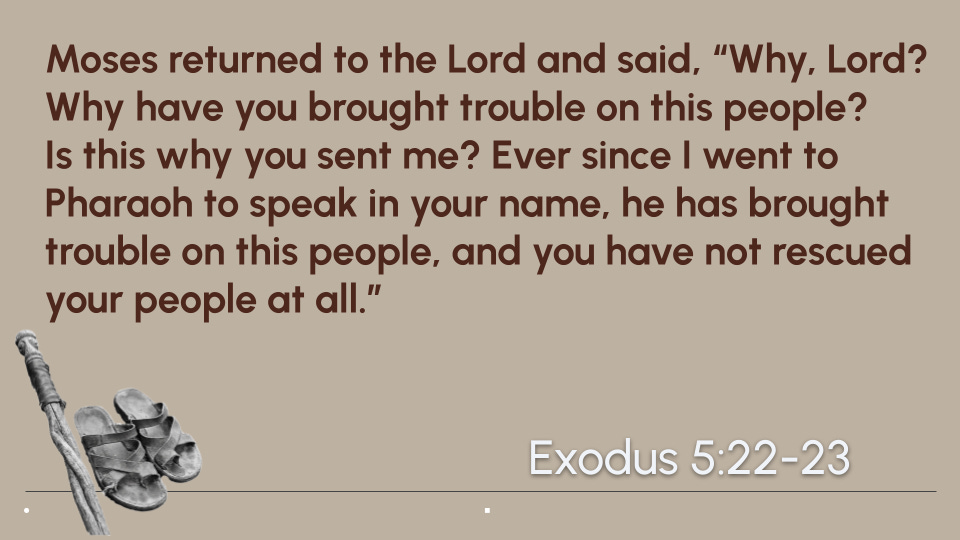
Finally, Moses is given the last word in this chapter of the Exodus story, and broken-hearted, he repeats himself.
God is patient. And God is always faithful. Both Moses and the Israelites experienced crippling despair in the face of their overwhelming circumstances. So do we, at times. And even when we return to our old excuses or go back to making bricks for the devil, God’s love and promises do not change.
The core message of these three chapters in Exodus is that God hears the cries of His people, remembers His promises, and acts decisively to deliver us.
There is hope. God sees, God hears, and God acts.
The Exodus Story is everywhere in the Bible. It is the overarching story of the people of God. The flight from Egypt is told explicitly in the books of Exodus, Leviticus, Numbers and Deuteronomy. Twenty other Old Testament books mention the departure from Egypt, the plagues, or the parting of the Red Sea. In the New Testament, there are ten books that tell bits of the Exodus story. And throughout the rest of the Bible, there are innumerable allusions and thematic nods to the Exodus. It would seem you can’t understand God or His people without the Exodus.
In the early church, the Exodus story takes on a new life. In 1 Corinthians 10, the wilderness wanderings serve as a warning for the early church. In the Faith Hall of Fame of Hebrews 11, the journey from Egypt to Canaan is cited as a primary example of faith development.
But, even more interesting are the ways the writers of the Gospels reach back into the Exodus story to inform their retellings of the disciples’ journey with Jesus.
John records the seven “I AM” statements of Jesus, clearly mirroring Yahweh’s seven “I will” statements in Exodus 6.
In all four Gospels, Jesus spends much of His time answering Pharaoh’s question, “Who is Yahweh?” He answers it most clearly in His completed mission.
Who is Yahweh? He is the one who provides salvation through His Son.
As Jesus walked this Earth, He sought out people who had the wrong answer to the question, “Who is Yahweh?” They were not Pagan Pharaohs or Gentile Kings. No, these false teachers were religious leaders in Israel. They had lost sight of God and completely forgotten who Yahweh was.
They were worse than Pharaoh because they studied the Torah and the Prophets and still got God wrong. Talking theology wasn’t a pastime for Jesus; it was primetime. The first time Jesus confronted the teachers of the Law is recorded in Luke chapter 2.
Jesus was just 12 years old.
It was the first year he was old enough to go with his parents to Passover. When the week of celebration was over, his parents headed home with a group from Nazareth. They walked all day, and only realised at bedtime that Jesus was not with them. The next day, they walked back.
Jesus called it: “My father’s business!” And he was serious about it.
In Mark chapter 3, the scribes tell everyone, “Jesus’ miracles are from the Devil!” This sets Jesus off. They are not just misunderstanding Scripture; they are calling Yahweh “Satan!” Jesus summons the scribes like a pack of demons and tells them to STOP! “You are Yahweh’s teachers! Teach the Truth! If you don’t fix your image of Yahweh, you will be guilty of the unforgivable sin – saying you know God and then lying about Him!”
“Who is Yahweh?” Certainly not Satan!
But when it comes to New Testament parallels of the Exodus story, Matthew shines above all the others. Matthew knows the Israelites love their story.
As the Early Church is growing, Matthew loves telling the Gospel using the Exodus as his template. From home to home, church to church, as he travels, he tells the story of slaves set free by Jesus. Just as Moses led them out of slavery to Pharaoh in Egypt, so Jesus sets us free from slavery to sin and Satan.
By the time Matthew finally sits down to write his Jesus story, his Gospel flows from his pen like milk and honey. Matthew is one of God’s Storytellers. He can break through people’s tough resistance to new Truth because he holds the storyteller’s secret. Tell a story people know and love. Tell it well. Then, once they are smiling and nodding at the familiar story, give it a new meaning.
Imagine Matthew preparing to write his Gospel. He lays out the scroll of Exodus next to an empty parchment.
Then he starts reading. “These are the names of the sons of Israel who went to Egypt…” (Exodus 1:1)
“I can do that,” Matthew thinks. He dips his quill into the inkwell and writes, “This is the genealogy of Jesus the Messiah, the son of David, the son of Abraham…” (Matthew 1:1)
Then there’s a birth story.
Birth of Moses. Birth of Jesus.
Pharaoh orders the killing of baby boys. Herod orders the killing of baby boys.
Moses grew up in Egypt. Hmm, well, Jesus and his parents did flee to Egypt and lived there for a few years. “That’s a cool connection,” Matthew thinks as he writes, “That will draw people into the story.”
The Hebrews leave Egypt.
Jesus’ family leaves Egypt to go home to Nazareth.
Then Yahweh opens the Red Sea, and the people walk through.
Oh, that’s like Jesus’ baptism when God opened the sky and His voice thundered His love for His Son!
You can see Matthew leaning into his writing now.
This is fun!
Next, slowly reading through the forty years of wandering in the wilderness, Matthew considers what the people learned on their long walk.
At the golden calf, they learned to have No other gods!
When mana fell from Heaven, they learned that God will provide!
When water flowed from a Rock, they learned - well, because Moses hit the rock in anger instead of trusting God, they learned different things. The people learned that God can provide water in the desert. And Moses learned that you should not put God to the test!
“Wow,” Matthew thinks to himself, “That reminds me of Jesus in the desert! The Israelites spent 40 years in the wilderness and barely learned a thing…. Jesus spent 40 days in the wilderness and never failed!
In every test, he quoted scripture.
Hmmm….” Matthew dips his quill again and leans over his growing Gospel. He is ready to write his greatest riff on the Exodus story.
You can check it out in Matthew chapter 4.
After his baptism, Jesus went into the desert, where he fasted for 40 days. The Devil came to Jesus at the end, when he was really hungry. “Hey, Jesus, what about these stones? They are about the size of loaves of bread. If you are the Son of God, tell these stones to become bread!”
“Jesus answered,
God will provide! Jesus is alluding to the story of the Exodus – and quoting from Deuteronomy chapter 8.
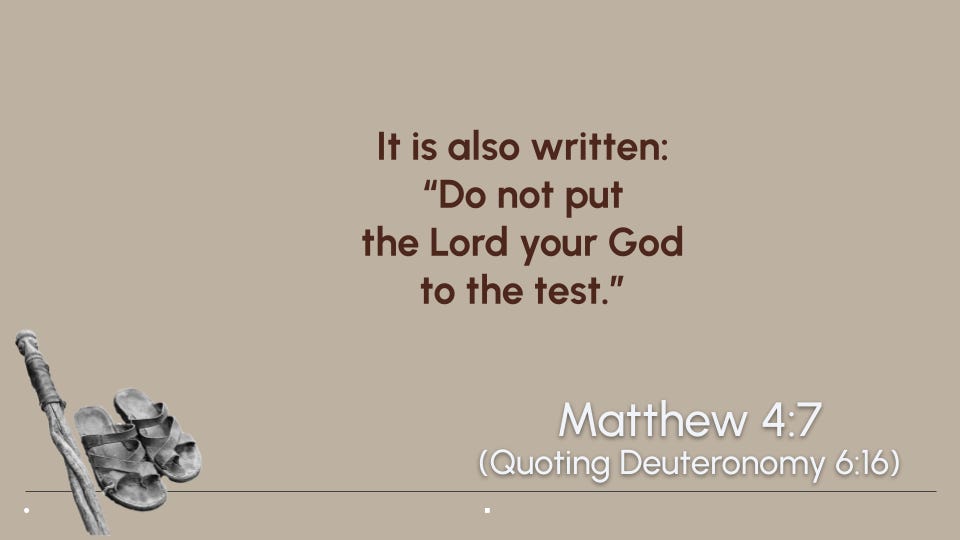
Then the Devil takes Jesus to the top of the temple and says, “Prove you are who you say you are. Jump. God has promised to protect you with angels if you are the Son of God!”
Jesus answered him,
Deuteronomy again, chapter 6.
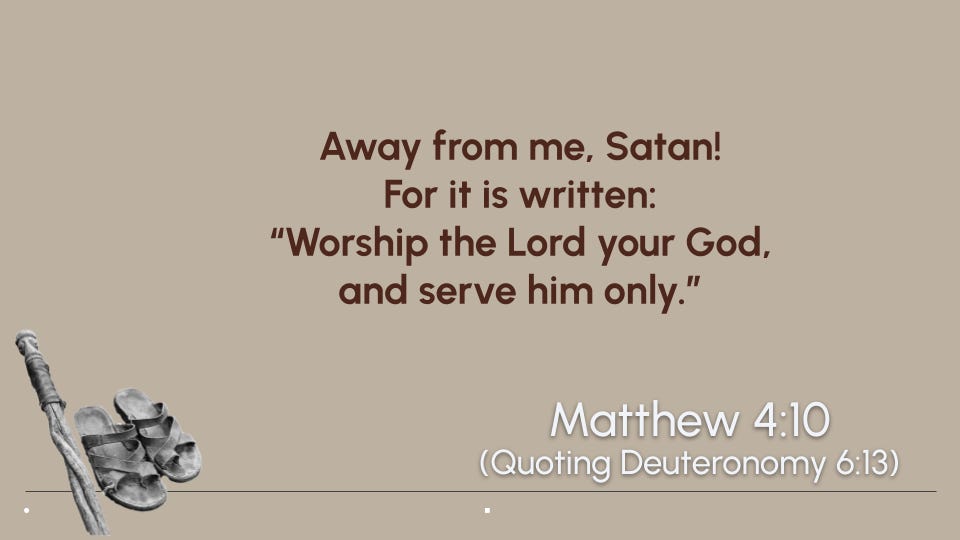
Finally, the Devil takes Jesus to a place with a really good view. So good in fact that the Devil can point out all the kingdoms of this world - their splendour and glory. “All of this, I will give you,” Satan said, “if you will bow down and worship me.”
You can almost see Jesus smile as he shakes his head.
“The golden calf? Really?
From the mountain top? Really?
Haven’t you been paying attention, you old snake?”
Jesus said to him,
Deuteronomy 6, again.
Satan spent all that time trying to trip Jesus up by challenging him to prove that he is the Son of God, and ironically, that’s exactly what Jesus does by resisting the Devil - he demonstrates his Divine nature. Matthew smiles and writes the end of Jesus’ desert story.
Forty days to prove that Jesus is different. He is better than Moses. Jesus didn’t fail and try again. Jesus didn’t learn the lessons of obedience from the Exodus stories. He embodied them.
Matthew is declaring, “Jesus is the new Moses - a new redeemer with a new, improved plan. A perfect covenant, written not on two stone tablets but on your heart! Jesus didn’t ask the Devil’s proxy for permission to set God’s people free. THIS Rescuer brought Salvation with Him! Jesus is our Saviour!”
As Jesus walked up the road to Golgatha, He carried with him an old wooden cross. The Romans were fond of crucifying people, and undoubtedly, this cross had been used many times to end many lives. Like the staff of Moses, there was nothing special about this cross or any cross. But, from this day forward, every cross of every empire would be seen as a reminder of this cross.
Who could have known that on this day, a cross would hold THE POWER OF GOD as sin was forgiven and righteousness released. The valley of the shadow of death would forever be overwritten by this mountaintop experience of the glory of God!
In this moment, the Cross of Christ brought life to all through the death of Jesus.
But death could not hold Him! On the third day, Jesus returned to life and, in doing so, promised us a resurrected life today! Then, forty days later, he ascended to Heaven - with a promise to prepare us a place in His Kingdom. Salvation was fully embodied and enacted in the life, death, resurrection, and ascension of Jesus.
Jesus. His name means YAHWEH SAVES. … YAHWEH SAVES! Jesus’ successful rescue mission guarantees your Salvation. YAHWEH SAVES in Jesus. This is the Gospel.
There are more parallels between Matthew and Exodus. But this is the greatest one. Jesus came to finish the work of the Exodus. He is our Deliverer and our Saviour. Jesus is the great I AM. The YAHWEH who SAVES!
And all the promises he made to Moses and Israel, he makes to you and me, today.
Today, because of Jesus, there is a clear answer to this question.
If you want to overcome life’s overwhelm, turn to Jesus.
He gives rest to the weary.
If you want to defeat imposter syndrome, turn to Jesus.
He equips the called.
If you want to know that you are safe, turn to Jesus.
He is your provider and protector.
If you want assurance that you are loved, turn to Jesus.
For there is no greater love than the love He feels for you.
Jesus. YAHWEH SAVES. You.



.jpeg)
.jpeg)